Samhain – The Origins of Hallowe’en
As you are reading this post, we are heading to that night known throughout the anglo-phone world as ‘Hallowe’en. Throughout much of the western world, people will be dressing up in costumes, decorating their houses and in other ways commemorating or celebrating the ‘other’ world; the world of those who have gone before us or of unearthly beings and powers. This usually means tacky stuff about witches, goblins, skeletons, ghosts and more modern sources of fear like serial killers, investment bankers, the AI and climate breakdown.
If you, the non-Irish reader, have ever encountered an Irish person and the subject of this time at the end of October and the start of November came up in conversation, you will know that we hold it to be very important culturally. To be blunt, you may have heard one of us claim we ‘invented Hallowe’en’, as reported below.

There is some element of truth in this. While every culture celebrates the turning of the seasons and most in the northern hemisphere marked the October harvest in some big celebration, the Irish version has left its imprint on much of our common culture. That version is the festival known as Samhain, pronounced with English orthography as ‘sow-an’. I’ll set out briefly what some of these traits are and also tell you about some distinct Irish practices that haven’t really moved beyond these shores. Indeed there are some that are unique to Dublin, but for now, here are the basics
Origins
At its simplest, the word Samhain is the Gaelic word for November; it is spelt the same way in Ireland and Scotland. It is one of the two major festivals in the Gaelic tradition, the other being Bealtaine (byee-alt-ana), the first of May. And, you will never guess, the Gaelic word for the fifth month is Bealtaine.
These dates are neither equinoxes nor solstices; rather Samhain marks the beginning of the darker half of the year and Bealtaine marks the return to the lighter half. Both were marked by large gatherings and festivals. In a primarily agricultural society in a temperate climate, they also are the two dates when cattle and sheep are moved from higher to lower pastures and back again – a practice known as transhumance. At Samhain, the domesticated animals were brought down to winter pastures.
These words and festivities seem to have originated in Ireland and then spread with the Gaelic tradition to Scotland, then versions have been bought to North America and other places of Irish and Scottish migration.
Traces
There are several elements of these festivities that feed into modern Hallowe’en. The first is that in the Celtic timing system, the day began as the Sun set. Thus the celebrations for Samhain began on what we would call the night of the 31st of October, known as Oíche Shamhna in Irish.
Secondly, both Bealtaine and Samhain were times where the boundary between the Otherworld and our world was briefly porous, so that the aos sí, the spirit folk (likely remnants of older pagan deities) could appear to mortals. It is notable that many of the Neolithic passage tombs that dot Ireland, Britain and northwestern Europe are aligned so that the interiors are illuminated on the first of May and the first of November. These structures are incredibly old; the massive neolithic tombs of Knowth and Newgrange (which is aligned for the winter solstice) are five thousand years old. Parts of the mythology of the later Gaelic culture of Ireland tries to explain the origins of these structures and viewed them as portals to the other worlds; the dates when they opened where those when they were illuminated by the Sun and so we have what seems to be a mythic feedback of explanation and source.
On a more personal level, Samhain also came to be associated in many parts of Ireland and Scotland with visits of family members and loved ones who have passed on. They come back to be remembered well, with certain foods and drinks, or, if they left in less loving circumstances, they may wish to exact some vengeance. Since you may not know which situation you are in, it is best to leave out an empty chair at dinner or an extra few slices of barm brac for them.
Fire
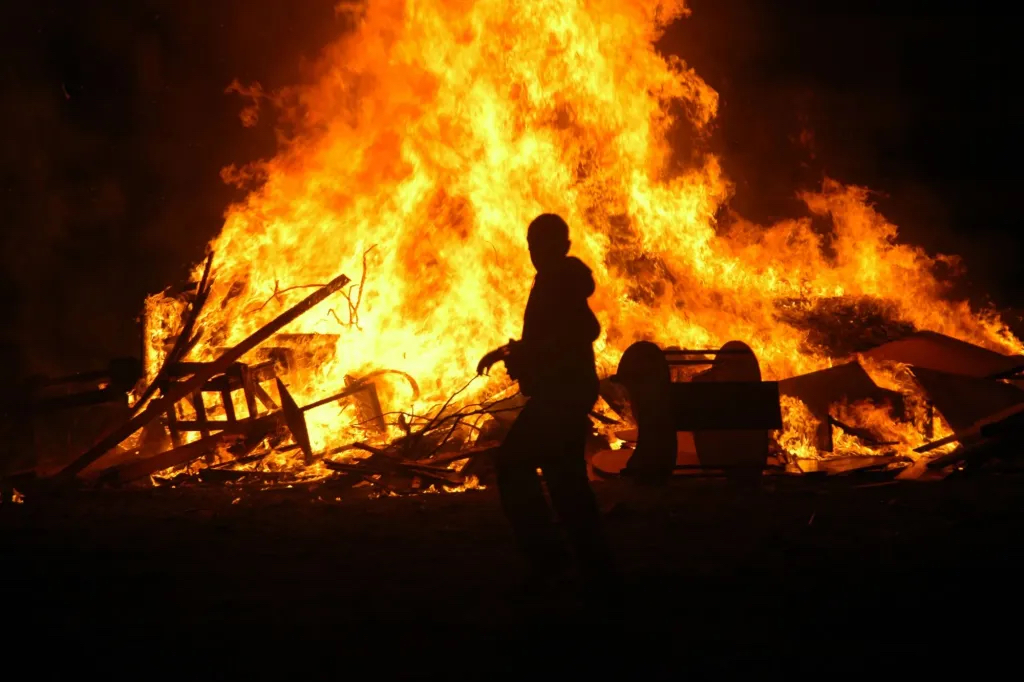
Thirdly, for both Bealtaine and Samhain, bonfires were lit at prominent locations, but naturally they would be especially important as we entered the darker half of the year on Oíche Shamhna. Aside from the naterual desire for warmth and light, the fires were seen as cleansing.
This is especially important for the modern experience of Hallowe’en in Dublin; the suburbs old and new are lit up with spectacular heaps of flame. There is a wide range of style, status and ambience. Depending on where you live, you could attend a well-managed bonfire, sanctioned by Dublin City Council, using non-toxic materials, with families in attendance and Dublin Fire Brigade monitoring for the danger of spread. Or you could head out to a vacant brownfield site where piles of rubbish, dead trees, tyres, cars, building frames, quite simply anything and everything that could burn is consumed by enormous fires that burn for days. Many of the organisers and attendees are in their teens and they can be somewhat hostile to the forces of law and order; a tradition for many of us sympathetic to our firefighters is to pray for a rainy Oíche Shamhna. But of course ambiguity abounds; if you are clearing out your house or garden in late October and have rubble that is mostly wood or plastic, you cannot be blamed if you leave it out the front on the street one evening and it is gone the following morning.
Unearthly Creatures
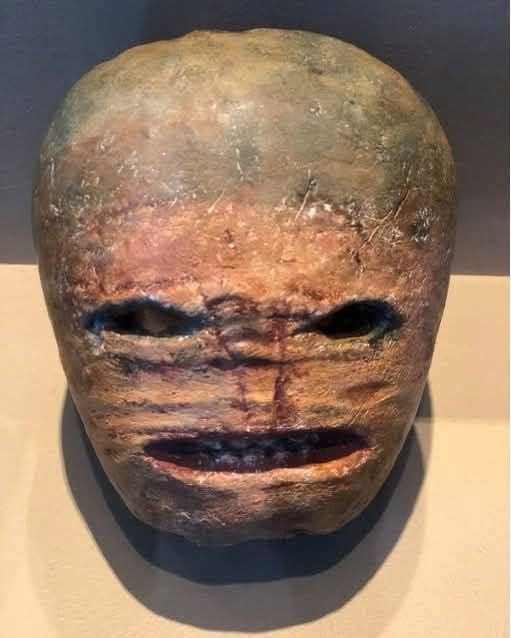
One of the core traditions for modern Hallowe’en, wherever it is celebrated, is the idea of dressing up in a costume, usually of something fearful, and gathering food and drink for a feast. This idea is widespread in European celebratory traditions, but the idea of doing it when marking the beginning of winter is very much to the fore in Ireland, along with the corollary that those who don’t contribute should be punished with a prank. This is felt intensely in Dublin; as a young fella I can remember the dread possibility that someone would drop some fireworks into your letterbox if you didn’t answer the door! The traditional greeting of those looking for gifts was rendered in Dublin as “Help the Hallowe’en Party!” Only Americans and people who watched too much TV said ‘Trick or Treat!’. A related tradition is carving faces from available vegetables; the photo below shows a ‘Jack o’ Lantern’ carved from a turnip. It can be seen in the Museum of Country Life in Mayo.
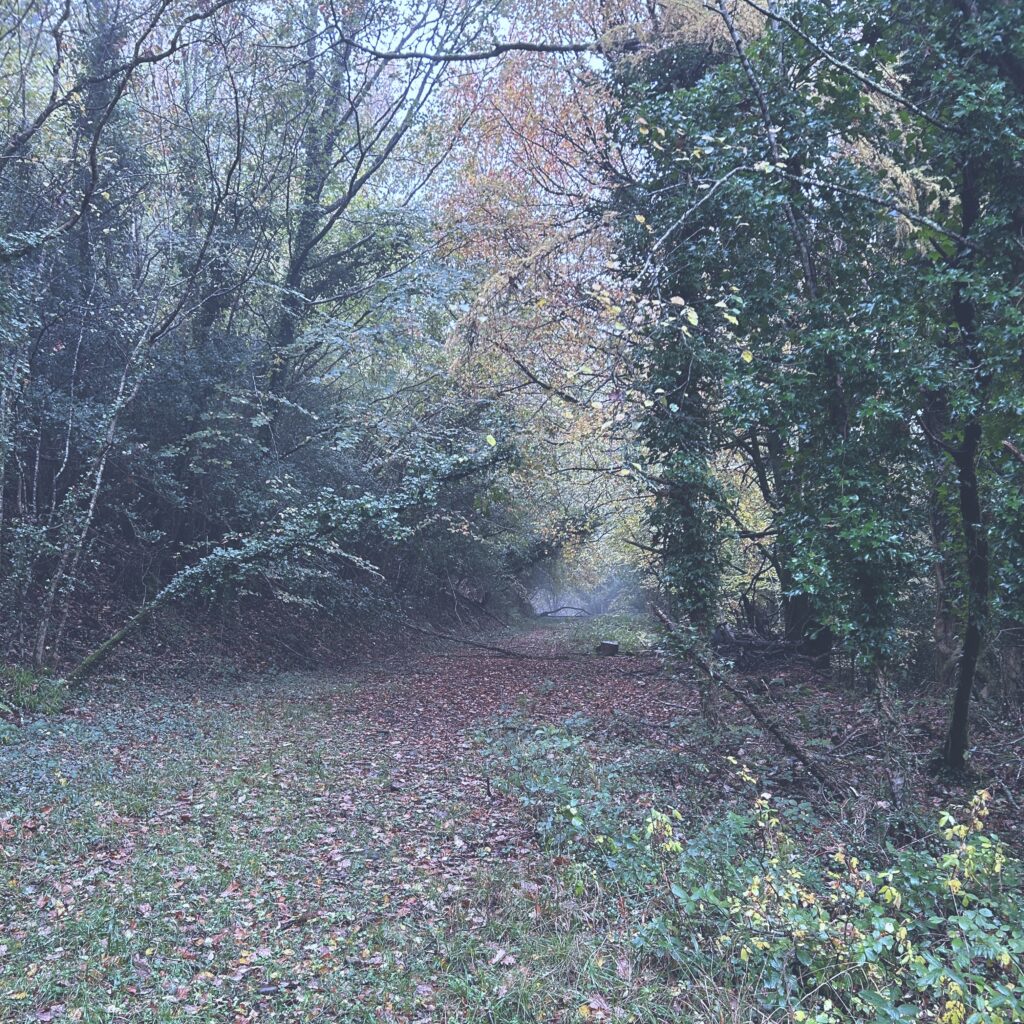
Linked to this is the question of who or what entity you are going to dress up as. One figure that was once quite popular is an Púca, the Pooka. This tricky fellow was widely known throughout Ireland and beyond – the English word ‘puck’ or ‘puckish’ comes from this root. The Púca is a general figure of mischief, but as the winter nights draw in, he becomes an irritating entity who jumps on your shoulders if you pass him on a trail and do not greet him politely. The fear of this happening would be especially acute on a green road (an older, unpaved trail) as twilight descends; I took the photo below yesterday on such a forest trail as a rather dense fog came in and I confess I was a tad nervous that I might meet or miss a shadowy fella with horns on his head. And of course that’s what Samhain is all about; embracing the fear that the light and warmth is gone and taking steps to share it with others.