
If you love fantasy, you already know Ireland’s stories, even if you have not yet read them. Gods who arrive in clouds of mist. A king who loses his hand and gains a silver one instead. A hero who sails to a land where nobody ages, only to return home and discover that hundreds of years have passed. Drama, violence, sex and death.
Long before anyone wrote ‘the Chosen One’ on a whiteboard, Irish storytellers were filling their world with supernatural powers, doomed heroes, magical weapons and hidden worlds sitting right next to our own. Here is a small taster, an amuse bouche, of these savage legends.
The Gods who Arrived in Mist
In most mythologies, there are immortal beings with extraordinary powers, usually referred to as ‘Gods’ by analogy with Greek mythology. They usually associate, for want of a better word, in a group, that group in turn residing in some class of otherworld.
In Irish mythology, our version of such a group is the Tuatha Dé Danann, meaning ‘the people of the goddess Danu‘. They are the heart of what scholars call the Mythological Cycle. According to the medieval Lebor Gabála Érenn (the Book of Invasions), they arrived in Ireland shrouded in darkness, lit up with flame, smoke and mist as they burnt the boats they arrived in. To establish themselves in Ireland, they first had to defeat the Fir Bolg, the previous inhabitants of Ireland, who had lived in Greece as slaves.
The Tuatha Dé brought four treasures: the Liath Fál, a stone (liath in Irish) which cries out beneath a rightful king; the Spear of Lugh, which once thrown never misses; the Sword of Nuada, which no one escapes once drawn, the Cauldron of the Dagda, from which no company leaves hungry.
Whether this supernatural race were thought of as gods or not, the words Fál, Lugh, Nuada and Dagda are cognate with very ancient Celtic names for gods. Thus the Tuatha Dé Danann may be seen as a final form of Irish paganism, told just as Christianity was taking hold and displacing them.
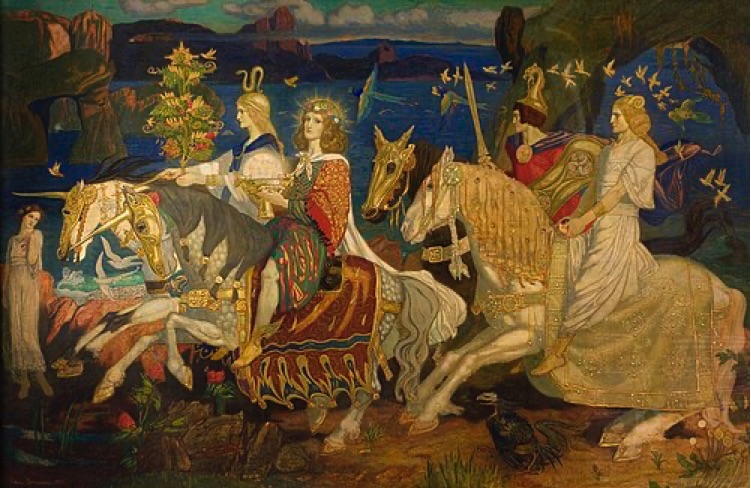
Their story has all the beats a fantasy reader wants. Their king, Nuada, loses an arm in the battle against the Fir Bolg for Ireland and, because a king must be physically whole in their traditions, is forced to give up the throne. A lesser ruler, Bres, takes his place and under his rule the Tuatha Dé are exploited and mistreated, while Bres himself repeatedly violates the obligations of kingship, particularly the sacred laws of hospitality. Cairbre, poet of the Tuatha Dé, composed a scathing poem about him, showing the deep roots of satire in Ireland. Eventually the Tuatha Dé physician Dian Cecht and the smith Creidhne fashion a new arm out of silver for Nuada, allowing him to challenge and defeat Bres.
Then comes Lugh. He arrives at the gates of Tara, the seat of the Irish High King where Nuada now rules, and the doorkeeper asks what he can do. Lugh offers his skills as a smith. They already have one. A warrior, a harper, a poet, a sorcerer, a physician? Each time the answer is that they already have one of those. Finally Lugh asks: but do you have anyone who can do all of these at once? They don’t, and so Lugh Samildánach (Lugh the equally skilled in all arts), the master of every craft, is let in. He becomes one of the great heroes of the Tuatha Dé, leading them in the Second Battle of Mag Tuired, against the Fomorians, a tyrannical race that had invaded and ruled Ireland since the time of Noah’s flood.
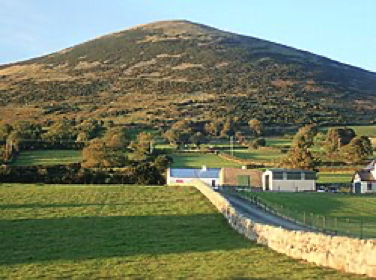
Afterwards, the Tuatha Dé lose Ireland to the Milesians, Gaels who sailed from northern Iberia. Because of their origins, the Milesians had brown hair, big noses and hazel eyes, thus accounting for the appearance of much of the Irish population to this day and explaining why we are always bedevilled with colds and flus. Rather than vanish, the Tuatha Dé withdrew to the Otherworld through the Sídhe, the hollow hills and fairy forts, and become the Aos Sí, the hidden folk. That is the origin of the fairy mound and of every ‘the old powers still live under the hill’ story since. More prosaically, it is a satisfying explanation for the inhabitants of Ireland in the early first millennium for the neolithic ruins they saw around them, an explanation that has held sway for generations.
The Hound of Ulster
If the Tuatha Dé are the gods of Irish myth, Cú Chulainn is its most famous hero, and one of the great tragic figures in that mythology. There are several legends associated with him, we will take them in turn.
Origins – Sétanta
He begins life as Sétanta, son of Deichtine, the Daughter of the King of Ulster (the Northern Province of Ireland), and Lugh, who we met earlier. Some stories have his birth as immaculate conception, in others Lugh takes Deichtine as his wife. Whatever his parentage, the boy is raised in the household of King Conchobar of Ulster, with all the greatest members of the court teaching him their skills and how to be a great man. One evening, the King and his retinue are invited to a feast at the house of Culann the smith. Sétanta is late, playing hurling; this is one of our national sports, played with a small ball and large flat, wooden bat called a camán, or a hurley in English. By the time he arrives at the feast, the gates are shut and Culann has loosed his enormous guard hound for the night. The hound attacks the boy. Sétanta, armed with only his hurley and a ball, drives the ball down its throat and kills it.
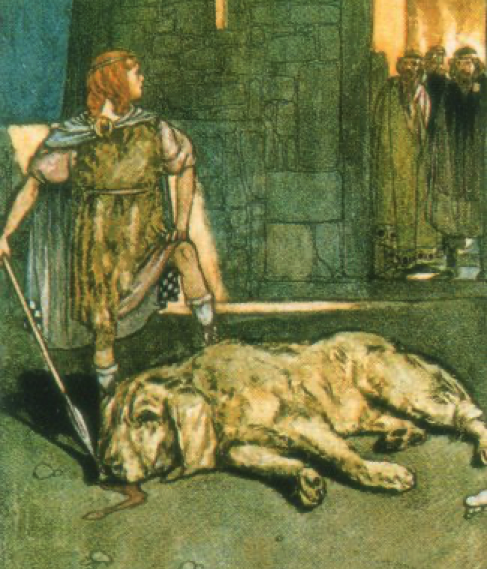
Culann is heartbroken, because the hound guarded everything he owned. The boy’s answer is to promise to raise a replacement pup, and to guard Culann’s house himself until it’s old enough. The Irish for hound is cú (coo), and so from that day he is Cú Chulainn: the Hound of Culann.
The rest of his life follows that pattern: a boy doing things no ordinary child should be able to do. When Cathbad the druid prophesies that whoever takes up arms on a certain day will have a glorious life of fame everlasting, Cú Chulainn, age seven, tries to take up arms to claim that glory, but all break under his already immense strength. He begs Conchobar for the King’s weapons which he then wields without them breaking, but Cathbad had not finished his prophecy, and weeps to tell them that the chosen warrior would have glory but live but a short life.
When he fought, he was said to sometimes undergo the ríastrad, the “warp-spasm”, a horrific transformation into a rampaging beast. One eye sinks into his skull and the other bulges out, his hair stands on end, his muscles swell and twist in his skin and his heartbeat becomes a lion’s roar. He loses the ability to tell friend from foe while in this state and is terrifying even to his own people. After one battle he returns to Ulster still in his frenzy, leaving the Ulsterman certain they will all also be slaughtered. He averts his eyes in shame when Conchobar’s wife, Mugain, and the other women of the court bare their breasts to him, giving the men an opportunity to wrestle him into several barrels of cold water which boil from the heat of his rage, until he eventually returns to normal.
He falls in love with Emer, the daughter of a Dubliner, Forgall Monach, who he had fallen for while they challenged each other with riddles. Forgall opposes the match and suggests Cú Chulainn studies under the warrior-woman Scáthach, in her Fortress of Shadows on the Isle of Skye, to become a great warrior to deserve Emer, though secretly he hoped the ordeal with kill the boy. Naturally Cú Chulainn survives and flourishes, learning how to used a terrible barbed spear, the Gáe Bulg, which is thrown with the foot and erupts with thorns inside the opponent, which must later be cut out.
His greatest test comes in the Táin Bó Cúailnge, the Cattle Raid of Cooley, where Queen Medb of Connacht invades Ulster to steal the prized Brown Bull of Cooley. The warriors of Ulster are struck down by a curse and cannot fight, so the young hero holds the border alone. He takes on Medb’s champions one at a time in single combat at the ford between provinces, defeating them all despite interference from forces both divine and mortal. After months of this, Medb sends his foster-brother and dearest friend, Ferdiad, against him, who is forced to fight no matter how much Cú Chulainn pleads for him to leave. They fight for three days as the warriors are equally matched, and each night they heal each other’s wounds and share food, until the last day, Cú Chulainn uses the Gáe Bulg hidden in the riverbed and kills him, then cradles the body and weeps. For all the supernatural monsters and magical weapons, this is one of the most human moments in the entire Ulster Cycle. It shows the kind of hero Cú Chulainn really is; he can defeat almost anyone, but cannot escape the tragic cost of his power.
The Death of Cú Chulainn
Eventually, that cost catches up with Cú Chulainn and the end, when it comes, is one of the most haunting scenes Irish mythology. Medb had spent years stirring up Cú Chulainn’s enemies, sons of those he had killed during the Táin and other battles, and launch a campaign against him. They know they cannot simply beat him in honourable combat, so they attack something more fundamental than his body: his geasa. A geis is a supernatural prohibition or obligation placed upon a person, the breaking of which spells ruin. Cú Chulainn has several. Among them is a prohibition against eating dog meat, his namesake. At the same time, refusing hospitality is itself a serious violation.
As Cú Chulainn rides out to meet them, his horse, Liath Macha, is said to weep tears of blood when it is harnessed. On the way he encounters three old women, the disguised daughters of a druid he had killed, cooking a dog. They offer him a share of the meat; if he refuses, he breaks the obligation to accept hospitality, but if he eats, he breaks his taboo against dog meat. He has no choice that leaves him completely innocent. He accepts and from that point, his supernatural strength begins to fail.
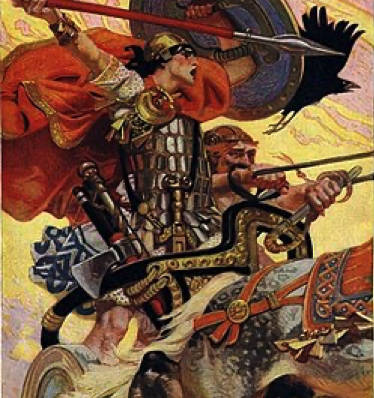
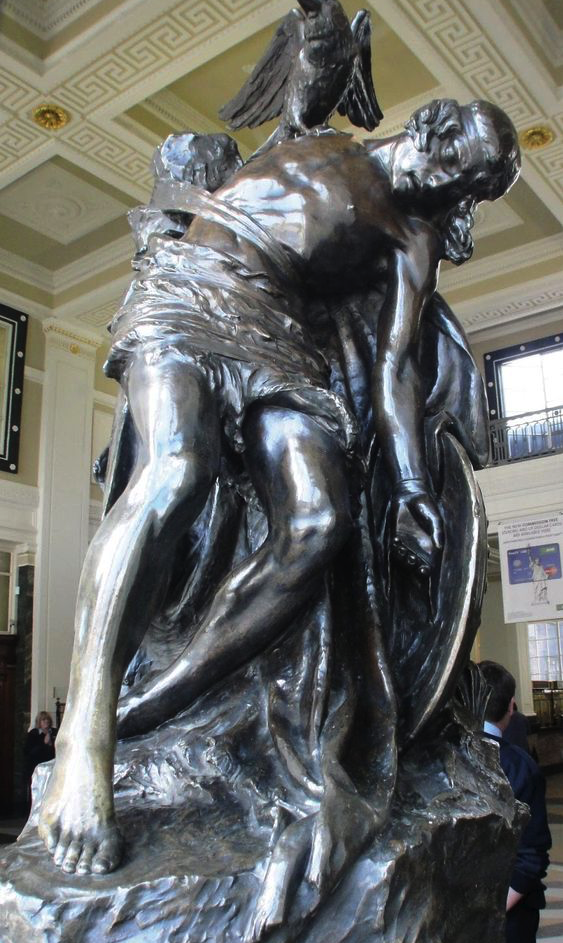
In the battle, his enemy Lugaid mac Con Roí has had three magical spears made, each with a prophecy that a king will die by it. The first spear kills Cú Chulainn’s charioteer, Láeg, the king of charioteers. A second spear kills Liath Macha, the king of horses. The third strikes Cú Chulainn in the belly. Mortally wounded, he refuses to fall. He drags himself to a standing stone, binding himself upright to it with his belt; when his legs give out he dies on his feet, facing his enemies. The sight terrifies the men so much they dare not approach, unable to tell if he is still ready and waiting to kill them. Only when a raven lands on his shoulder and pecks at his eye do they finally understand that he is dead. Lugaid steps up and cuts off his head, but as he does so, Cú Chulainn’s body bursts into light and the hero’s sword falls, severing Lugaid’s own hand.
Cú Chulainn in Dublin
This scene is immortalised in the heart of Dublin. In the General Post Office on O’Connell Street stands Oliver Sheppard’s bronze statue The Death of Cú Chulainn, showing the hero collapsed against his pillar stone with the raven on his shoulder. It commemorates the 1916 Rising, showing how deeply these stories became embedded in Irish ideas of heroism, sacrifice and national identity. Cú Chulainn wasn’t just an ancient warrior, he had become a symbol.
The Man who Touched the Ground
Where Cú Chulainn’s story is about glory and its price, the story of Oisín is about the price of paradise. He is the poet-son of Fionn mac Cumhaill, leader of the Fianna, the great warrior-band of the tales of the Fenian Cycle, considered the greatest poet of Ireland. One day, while the Fianna are out hunting, a woman rides out of the sea on a white horse. She is Niamh Chinn Óir, ‘Niamh of the Golden Hair’, daughter of the sea-god Manannán mac Lir, and she has come to find Oisín. She has heard of his poetry and his courage and she asks him to come away with her to Tír na nÓg, the Land of the Young, in part to help break a curse upon her set by her father. The King of Tír na nÓg was chosen every seven years by a race and Manannán was prophesised to only lose against his son-in-law. He turned Niamh’s head into that of a pig, in the hopes no man would ever marry her.
Oisín, however, agrees to help and goes with her, travelling across the ocean on her magical horse, defeating her father and ruling as King. In Tír na nÓg there is no sickness, no age and no death, only music, feasting, hunting and endless summer. He is happy there for what feels to him like three years. But in time, he longs for home and for his father and his comrades in the Fianna. Niamh does not want to lose him, but she gives him the white horse and a warning: whatever he does and wherever he goes, he should not set foot on the ground.
Oisín rides back across the sea and finds a changed Ireland. Everyone he knew is long gone. The great halls of the Fianna are overgrown ruins. The people are smaller, weaker and have never heard of the heroes he mentions, except in legends. The three years that passed in Tír na nÓg had been three hundred in the real world.
As he wanders the countryside, Oisín sees a group of men struggling to lift a huge stone. Wanting to use his great strength to help them, he leans down from the saddle to grasp the rock, shocking the men as he lifts the stone with one arm. However, while the strength of his body is immense, that of the saddle is not; the girth snaps, pitching him from the back of the horse. He falls and when his feet hit the ground, those three centuries arrive all at once. In the later versions of the tale, he is left a blind and withered old man, but according to some versions he is brought to Saint Patrick, with whom he spends the rest of his days recounting the tales of old to and arguing about faith and morality.
Still Shaping the Genre
You can see the style of these stories from these few examples. Like Greek or Roman mythology, the supernatural entities, possibly Gods, are essentially larger than life human characters. Unlike that Classical material and more like the mythologies of other peoples that have not been through the wringer of decades of crushing rewrites and tedious analysis, the chaos, wildness and bawdiness of the original stories still impress. Many of the heroes of these stories kill or are killed in the most gruesome and brutal fashion.
The Irish mythological tradition is one where the Otherworld is never far away. It is under the lake, across the sea, or inside that nearby hill, not on top of some distant mountain. Your mother will tell you these tales when you are a child, alongside the misdeeds of the British, to show you the thread of Irish history that reaches back to deep time for meaningful archetypes. The door to that world opens at Samhain, pronounced with English phonetics as ‘Sow-an’, which is also known as Halloween. These are stories where the supernatural is always close, the heroes come to know that they are doomed and the price of using powerful magic is always paid.
See it for Yourself
Irish myth is attached to real places. The Hill of Tara, ancient seat of the High Kings and home of the Stone of Fál, and Newgrange, the Neolithic passage tomb linked in legend to the Tuatha Dé Danann, both lie in the Boyne Valley, an easy trip from the city. Here you will see why the Irish people of two millennia ago needed to explain where the ruins from three millennia came from.
In Dublin itself, the National Museum of Ireland’s archaeology branch on Kildare Street holds the gold, the bog bodies and the strange Iron Age treasures of the world these stories grew from. At Trinity College, the Book of Kells shows how deeply storytelling and monastic scribes were entwined, even as Christianity gripped the land.
Dublin has hosted Worldcon before and we know how much fantasy fans love to explore. Come to Dublin in 2029 and bring your questions about the Otherworld. We can’t promise you’ll find the door, it’s probably best if you don’t, but we’ll happily point you towards the hills.