
The purpose of this blog, indeed of our website, is to highlight the links between Speculative Fiction and Fantasy and the city of Dublin. To this end, every once in a while, we will talk to you about SFF writers, creatives and such of their works that are intimately or even peripherally associated with our City. Dublin’s reputation as a city of literature is well grounded – it is one of the few cities in the world, possibly the only one, where three of its natives have been awarded the Nobel prize in literature. You have probably heard of Yeats, Wilde, Beckett, Joyce and so on, who either spent some of their formative years here or were born here and, in the finest tradition of our people, left. Those raised in the Irish education system may indeed be suffering, to paraphrase the late, great ‘Babs’ Keating, from illness and fatigue at the mention of their names. We’ll be focussing on writers that are perhaps less well known to the literati but who are appreciated in SFF circles. Hopefully we will bring you some names of Irish SFF writers you may not have heard of.
We will start this series with a writer of the fantastic who, until recently, was well known in Ireland but perhaps less well known further afield – the great Flann O Brien, who was born in Strabane in County Tyrone in 1911, on the 5th October, today’s date.
That name was a pseudonym, but it is the pen-name used for his four English language novels and so by which he is known internationally. His real name was Brian Ó Nualláin, in English Brian O Nolan, and he was also known here in Ireland as Myles Na gCopaleen. This reflects one of the defining features of O’Brien; his distinct and separate lives. As Brian O’Nolan/Brian Ó Nualláin, he was a senior civil servant working for the newly independent Irish state. As Flann O’Brien, he was a novelist experimenting with the boundaries of fiction, language and reality. As Myles na gCopaleen, he was a newspaper columnist, satirising Irish society, politics, bureaucracy and nationalism.
His inspiration for the fluid realities and experiments with language could be said to come from his early life and its backdrop; the violent and tumultuous early twentieth century in Ireland. These years are known as the Revolutionary period here, as it saw the likelihood of Home Rule in Ireland, the violent reaction of Ulster Unionists to that prospect, the impact of the First World War on Ireland, the Easter Rising of 1916, the War of Independence of 1919 to 1921, the partition of the island into Northern Ireland and the Irish Free State/Saorstát Éireann and then the bitter Irish Civil War within the Free State. The late 19th and early 20th centuries also saw the ‘Gaelic revival’, a movement of artists, writers and revolutionaries to promote, revive or create a distinct Irish identity. This notably included attempts to revive the Irish language, an official policy of the Irish government to this day.
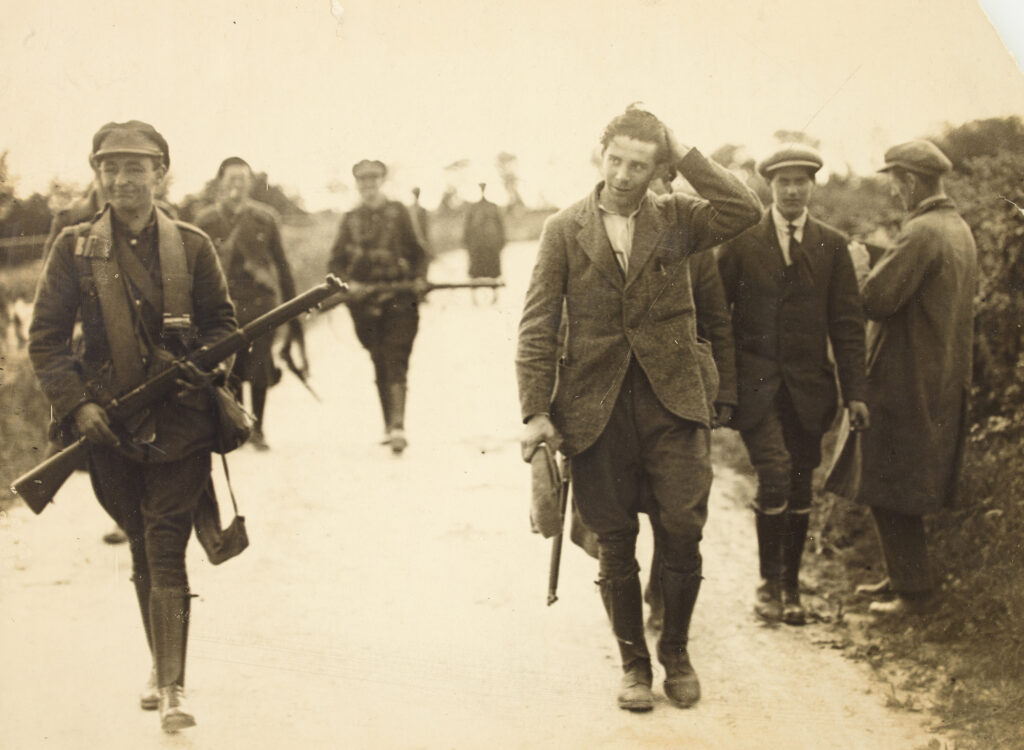
Ó Nualláin sat at the intersection of much of the contradictions and paradoxes that this period created. His father, Michael O’Nolan, had been a customs officer in the British government, travelling all over Ireland and Britain for his work. He had strong Republican views; in an Irish context, this means separatism as well as anti-monarchism. He naturally concealed these political leanings from his employer, but yet gave his children Irish names, many in the original Irish spelling, a common habit among those trying to revive or create a non-British Irish identity. When the Irish Free State came into being, O’Nolan senior joined the new Irish Revenue Commissioners and eventually moved to Dublin where the family remained.
This background of cultural and political ferment leaves traces in Flann O’Brien’s work. Names like Brian O’Nolan, which had deep Irish roots, had been rendered into English for decades or longer and were now being converted back to the original – Brian Ó Nualláin. A new state founded in revolution, that many of its citizens and indeed a significant number of the revolutionaries themselves felt was incomplete, established itself as a miniature copy of the state from which it had separated. The radicalism of the revolutionary period gave way to a deep, insular conservatism. One strange outcome of this background that this writer still remembers from first reading ‘The Third Policeman’ and ‘At Swim Two Birds’ is how difficult it is to pin down when and in what version of Ireland the events occur in; much of the background suggests a pre-revolutionary time, though the details of daily life are reminiscent of the 1930s. It reads like a blend of alternate history and fantasy.
Flann O’Brien is best known for five novels, four in English and one in Irish. The English-language novels are At Swim-Two-Birds (1939), The Hard Life (1961), The Dalkey Archive (1964) and The Third Policeman (1967). The Irish-language novel An Béal Bocht (1941) (pronounced with English phonetics as ‘on bale bokht’) was written under the name Myles Na gCopaleen and he also wrote a newspaper column, Cruiskeen Lawn, with this pen-name. The name of this column is the transliteration of the phrase ‘an crúiscín lán’, which means the full small jug.
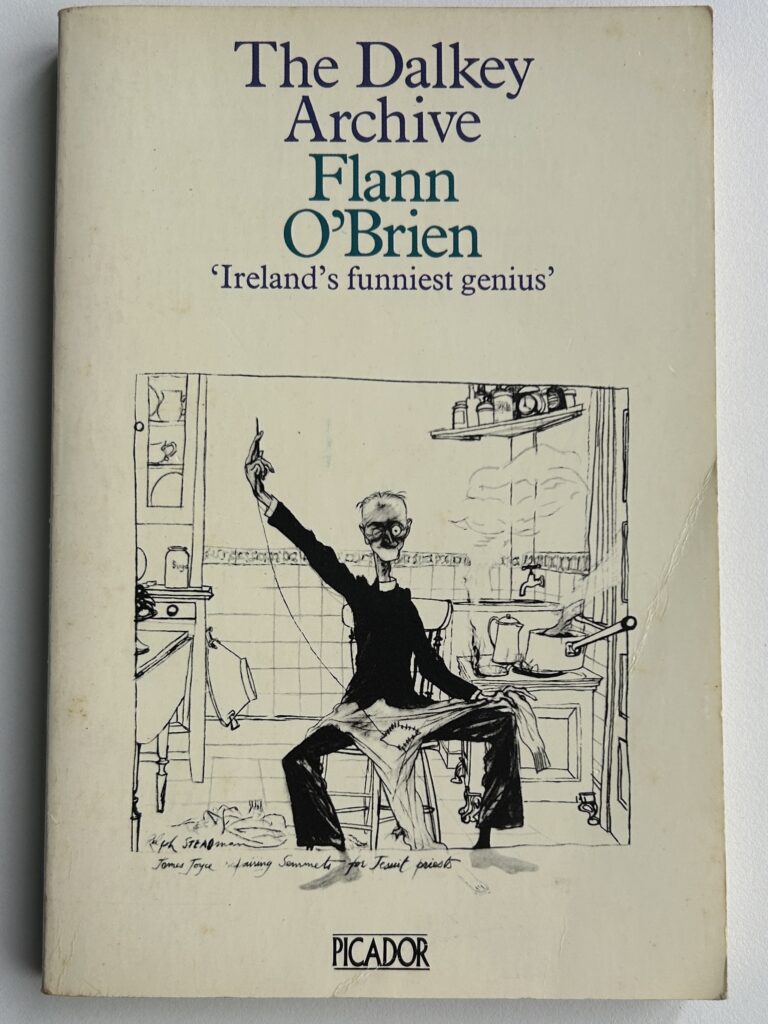
O Brien’s novels are primarily satires on aspects of Irish cultural and occasionally political life, but go much further in their artistry and structure. At Swim-Two-Birds is an early and important example of meta-fiction – the student who is ostensibly the protagonist of the novel is himself writing a novel and his characters escape his control and put him on trial. Jorge Luis Borges was, appropriately, very impressed with this aspect of the novel. Another thread of this book is written in a style that is an attempt to render into English the Middle Irish language that many of our most ancient legends are written in – an extraordinary experiment that bears unusual fruit. One of the legends featured here is about Mad King Sweeney, Suibne Geilt, a figure from the boundaries of Irish history and mythology, who resisted the spread of Christianity to Ireland. Amongst all this chaotic narrative and subtle language, the book is outrageously funny and absolutely enthralling.
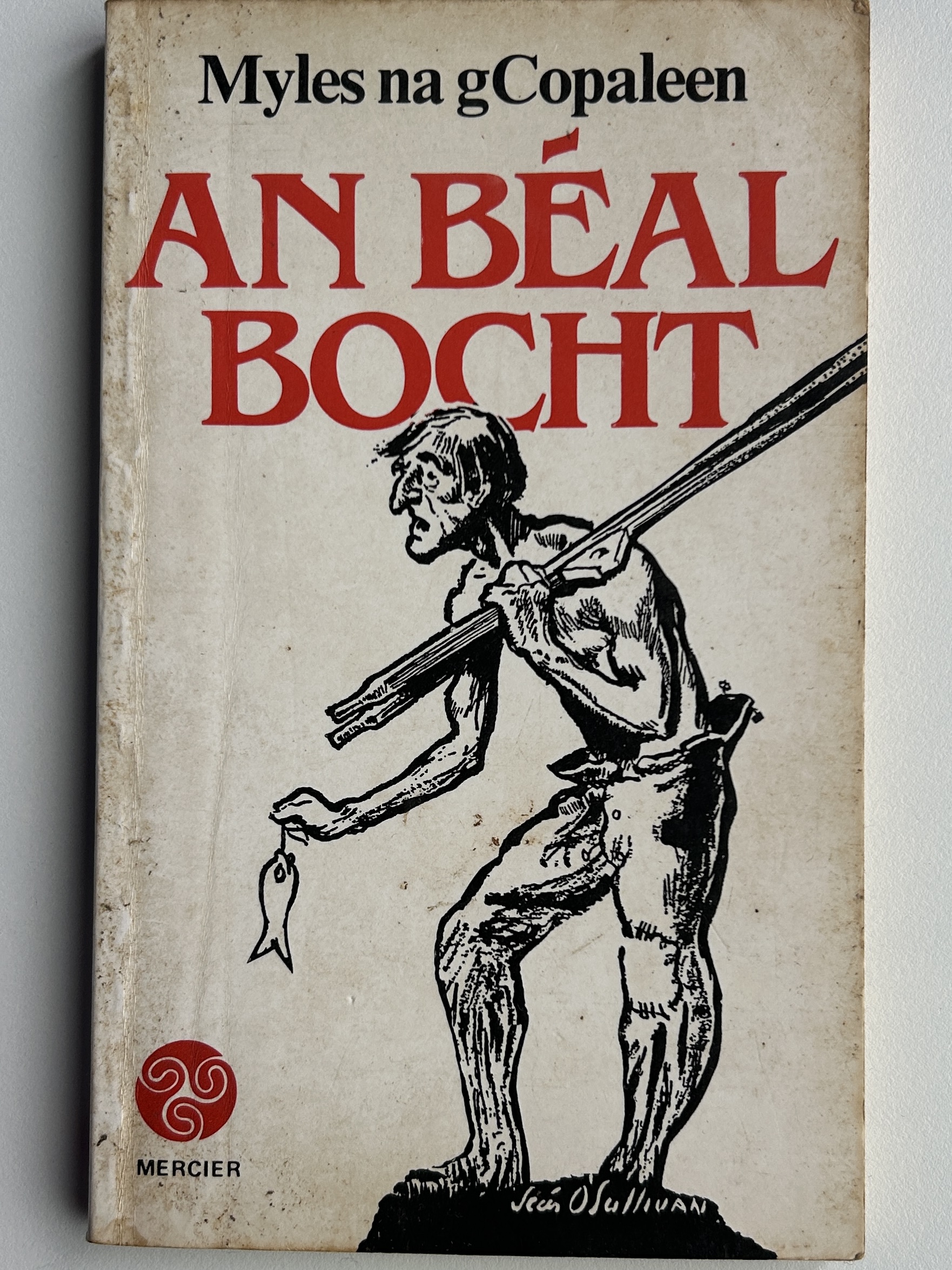
The Third Policeman starts as a story about theft and possibly murder in rural Ireland, yet gradually becomes more and more surreal. The landscape in which the protagonist moves has strange features and unusual occupants, not least the policemen referred to in the title. Again, O Brien does strange things at the intersection of the two languages and of historical time. This novel introduced his bizarre ‘atomic theory’ and its relevance to the dangers of excessive use of bicycles. It also features the scientist and philosopher de Selby, the ultimate mockery of academic debate, in a seres of enormous pseudo-scholarly footnotes in tiny fonts. Very similar if not identical material was used in the book The Dalkey Archive, because although The Third Policeman was written in 1939/40, it was rejected by publishers and only came out in 1967, the year after Ó Nualláin’s death.
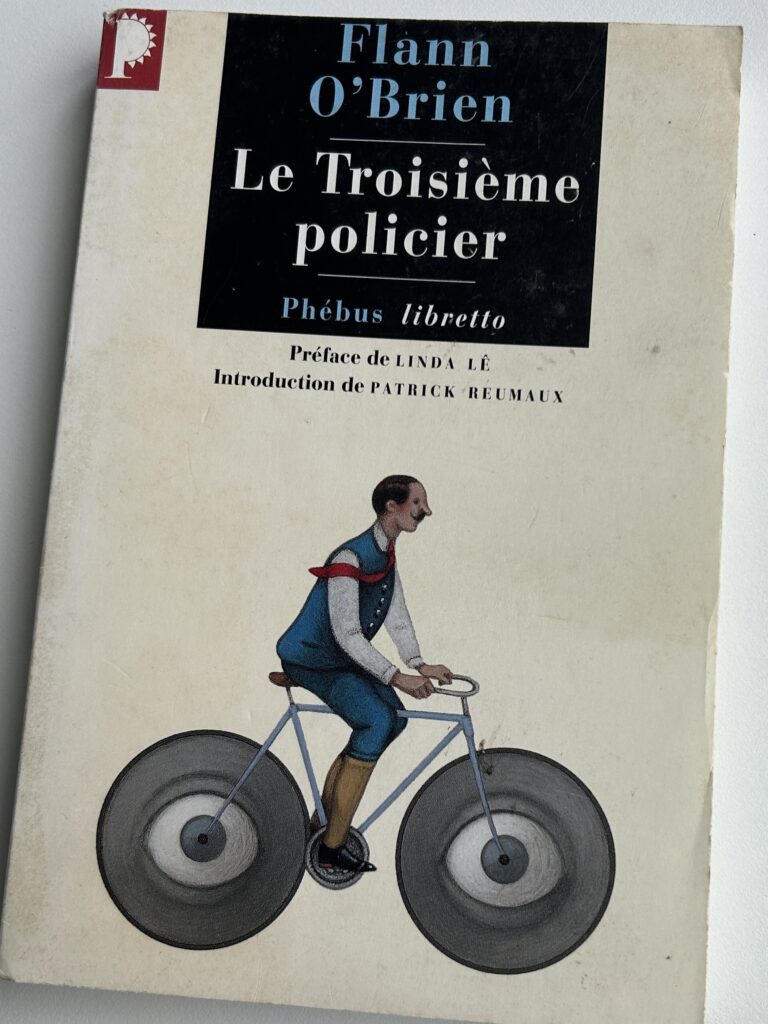
An Béal Bocht shows again the paradoxes at the heart of Ó Nualláin’s work. He spoke Irish fluently and was an admirer of many of the significant writers in Irish of the early twentieth century. Yet he pushed make against the restrictive vision of Irish identity depicted in accounts of the lives of the impoverished, Irish-speaking inhabitants of the west of Ireland. The title of the book comes from the Irish phrase ‘an béal bocht a chur ort’, literally to put on the poor mouth, meaning to exaggerate ones own misfortune to gain sympathy (the title of the English translation of the book is The Poor Mouth). Thus An Béal Bocht is a satire of that genre, though at times a fond satire. It notably highlighted the clash between the real people behind this vision and the middle-class academic Irish-language enthusiasts who sought to find this version of Irishness among the peasantry, but then direct and control it. In a way, An Béal Bocht asks what if the petiole of Ireland actually were as the official nationalism wished them to be. This is arguably a familiar story across the world, yet in that particularly Irish context of turbulent cultural change and the numerical collapse of the language itself, in part driven by the high emigration that is an inevitable consequence of poverty. Yet again, this serious intent did not prevent the book being genuinely, laugh-out-loud funny – the twists and turns of language here are a delight.
Ó Nualláin was a well known and well liked member of Dublin’s literary circles. He and the poet Patrick Kavanagh established BloomsDay, a walk around Dublin City following the protagonist of Joyce’s Ulysses, despite the fact that Ó Nualláin once said “I declare to God if I hear that name Joyce one more time I will surely froth at the gob” and mercilessly satirised Joyce in The Dalkey Archive. He was elevated to the status of a Dublin ‘character’, which needless to say he relentlessly mocked. Yet he was plagued with ill health and alcoholism and died in April 1966 at the relatively young age of 54. There is far more to his life and work than I have outlined here, but I do hope it draws you in to reading his work and seeing it in its context.
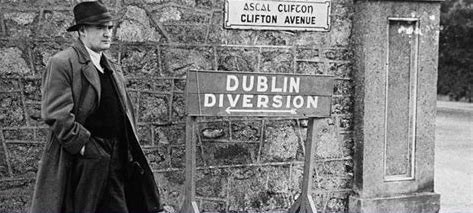
This final photograph of Brian Ó Nualláin is very well known and loved by his fans; in Dublin, describing someone as a ‘diversion’ meant they were entertaining company.