Dublin’s Oldest Bookshops
There are 63 UNESCO Cities of Literature worldwide, chosen for qualities such as a strong literary identity and history, substantial contemporary literary ecosystem and support and accessibility for creative industries. Dublin has held the title of UNESCO City of Literature since 2010; anyone who has walked its streets looking for a book will see why! Join us for a look at some of the oldest bookshops in Dublin; some of them have been selling books for longer than (for example) the United States has existed.
Hodges Figgis – The Eldest
Hodges Figgis is a cornerstone of Dublin’s literary heritage; it has been trading since 1768, when property owner John Milliken opened it on Skinner’s Row (now Christchurch Place). It is Ireland’s oldest bookshop and, by most accounts, the third-oldest in the world, after Lisbon’s ‘Livraria Bertrand’ (1732) and the ‘Moravian Book Shop’ in Pennsylvania (1745). It has moved several times over the years, to Grafton Street, then Nassau Street in 1920, then in 1945 it moved to its current place filling four wonderful floors at 56–58 Dawson Street.
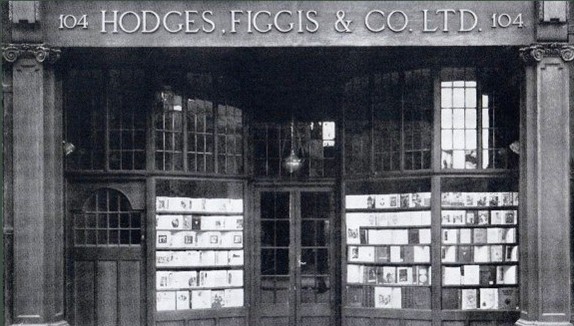
For much of its history, Hodges Figgis was more than a bookshop, it was also an important publisher of Irish scholarship, producing works on history, archaeology, literature, language and the Celtic tradition. Among its significant publications was John O’Donovan’s monumental edition of The Annals of the Kingdom of Ireland by the Four Masters, published in the nineteenth century. The firm’s publishing history reflects the important role Dublin played as a centre of scholarship and the preservation and study of Ireland’s literary and historical heritage.
The shop has also been in literature for as long as it has been publishing or selling it. Joyce slipped it into Ulysses as one protagonist recalls “the virgin at Hodges Figgis’ window on Monday looking in for one of the alphabet books”. Poet Paul Durcan wrote a poem about spotting an author secretly signing her own books on the shelves. Sally Rooney set a whole chapter of Conversations with Friends here. It is clear that the shop is woven into the literary fabric of Dublin.
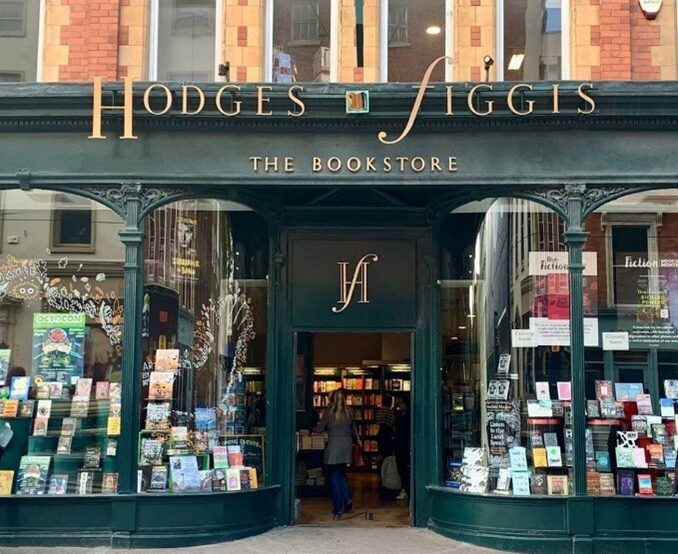
If you want to hear more about Hodges and Figgis, spare four minutes for this piece from Irish radio on its 250th anniversary. On a more scabrous note, if you wish to impune the honesty or reliability of the shop, you may refer to it as ‘Hodges Dodges.’ Naturally we can think of no reason why would want to do so.
Books Upstairs – The Independent Spirit
Books Upstairs bills itself as Dublin’s oldest independent bookshop. It was opened in May 1978 by two friends, Maurice Earls and Enda O’Doherty, in n a former hairdressers above a furrier shop on South King Street. They took out the old hand basins, built the shelves from scratch and painted the furniture bright cherry red. The shop was to be a place that backed the positive role of books in Irish culture. As well as literature, history and politics, they stocked works on philosophy, feminism and gay literature that few bookshops carried at the time. The shop is still independent and family-run, and it has moved a few times through George’s Street Arcade and College Green (see the accompanying photo).
Since 2015 it has lived in a Georgian building at 17 D’Olier Street, with interconnecting rooms over three floors, a first-floor café and a secondhand section added in 2019. Louisa Earls, Maurice’s daughter, who manages the shop, was named Bookseller of the Year in 2025 by O’Brien’s Press, Ireland’s leading publisher, so you know you’re in safe hands!
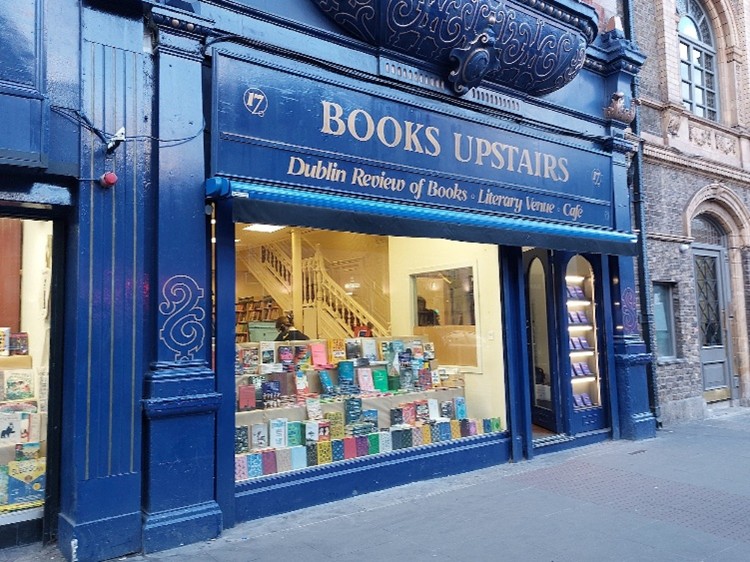
It is also the headquarters of the Dublin Review of Books, a magazine devoted to essays and reviews on new works, and reflection on Irish and international themes. Perhaps after visiting this wonderful shop you will be inspired to submit something? They welcome reviews from all contributors. Only about a 15-minute walk from our proposed convention centre.
Ulysses Rare Books: The Collector’s Den
Ulysses Rare Books on Duke Street was known for decades as Cathach Books, named after Ireland’s oldest surviving manuscript psalter. Enda Cunningham started the business in 1969 as a part-time gig issuing catalogues, before setting up a physical location in South Great George’s Street in 1969. The shop moved to Duke Street in 1988 and his two children joined him in running the business. He was described in his obituary as “the Don Quixote of Duke Street, the deep-pocket multinationals and chain stores were his windmills, and he didn’t tilt at them as much as he defied them.”
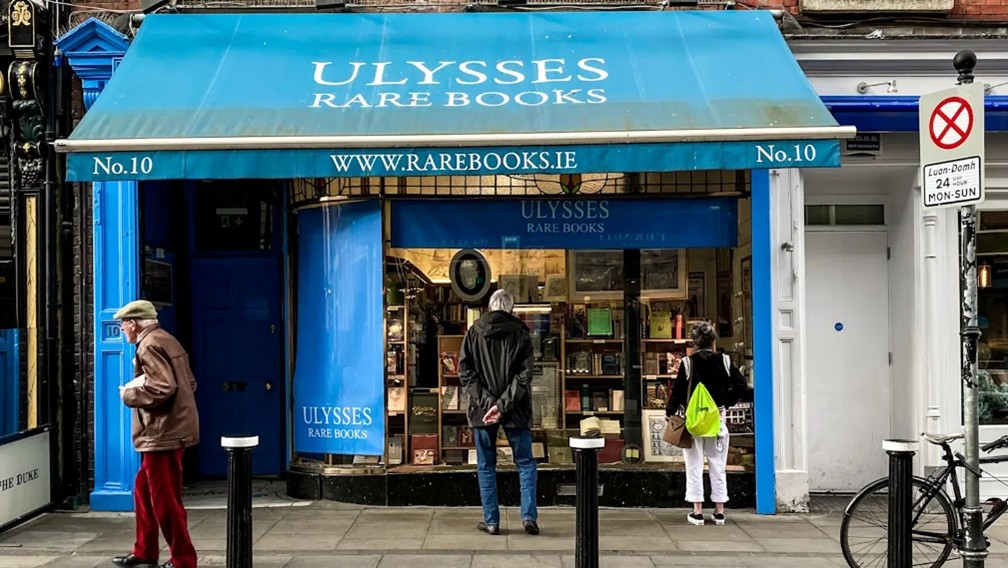
The shop was renamed Ulysses Rare Books on Bloomsday (June 16th) in 2013. Entering this shop will feel slightly akin to a holy experience for book lovers, as the shelves hold an unrivalled selection of first editions of Heaney, Beckett, Joyce, Wilde, Yeats and many others. Specialising in Irish literature, history and topography, hosting rare maps from the last 17th century onwards in the basement. As you browse, check atop the bookshelves, as a charming mural runs along the perimeter of the shop depicting writers and famous Dublin locales. See how many can you name.
Located about a 20-minute walk from the Convention centre, it is a must visit for lovers of beautiful books. Keep an eye out while you’re there, as Irish authors such as Anne Enright, Joseph O’Connor and John Banville, are known to frequent the shop.
Greene’s of Clare Street: One We Lost
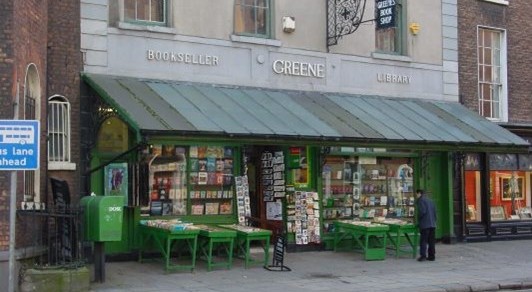
Any tour of old Dublin bookshops should mention Greene’s, a loss to Dublin’s literary scene. From its home on Clare Street it traded from 1843 until 2007, its book barrows sitting out to the front of the shop. These would stop even the most delayed of white rabbits for a quick browse. In many ways, the loss of Greene’s is emblematic of the loss of dozens of small bookshops that dotted the streets of the city until the 1990s; many had a parlous existence in older, run-down buildings that were rip for development.
Greene’s began as a lending library set up by John Greene, following which the Pembrey family ran it from 1912 until it closed due to declining foot traffic in that part of the city. The shop has moved online since and though the physical store is gone the street is still worth a wander for the Georgian architecture and for the ghosts of the shop. RTE once again provides a concise and interesting history of this lost gem.