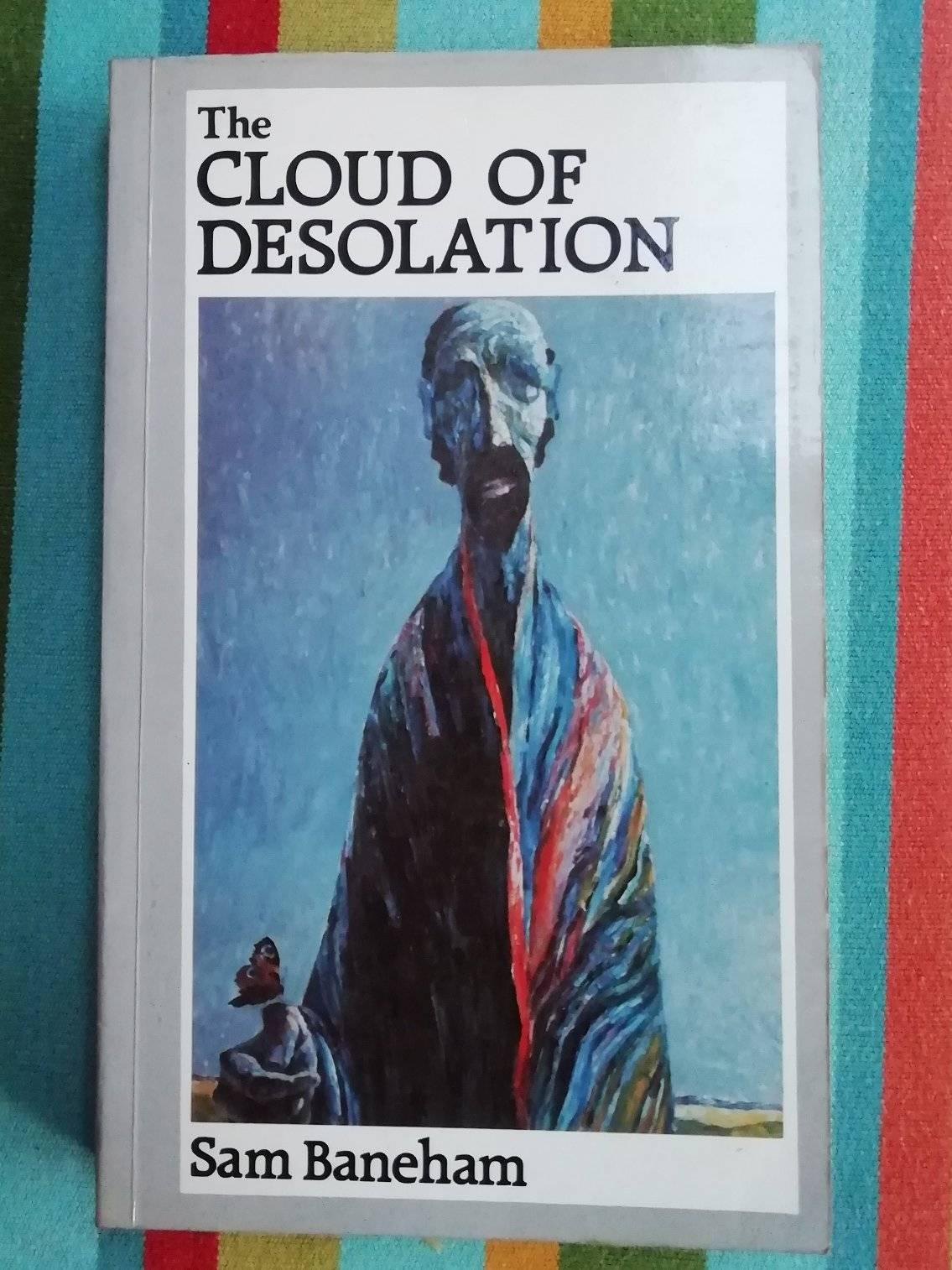
The Cloud of Desolation by Sam Baneham
Over the course of the next year, as we anticipate the vote on the site of the 2029 WorldCon, and in the following two years as we (hopefully) prepare for the 87th WorldCon in our City, we will be sharing reviews and discussions from our volunteers of books, films and other works of SFF that have impressed or moved them. Here is my own contribution.
A forgotten Irish Dystopia
This book was published in 1982 by a now-closed small publisher based in Dublin called the ‘Wolfhound Press’ and has never been re-issued. I’m not sure how many copies were printed, but I have rarely seen it mentioned in written SF circles. I have only ever seen four or five copies on sale, of which I now own two. In other words, it shares a very similar history as ‘They’ by Kay Dick, except without being re-discovered.
The writer was Sam Baneham and I can find very little about him, other than the brief statement in the books biography that he was born in Dublin in 1947 and worked as a teacher in Oldcastle, a town on the far side of county Meath, near the border with Cavan. Today it is a town heavily influenced by being within commuting distance of Dublin, but 45+ years ago it would have been relatively rural. This book is, as far as I know, the only work by Baneham.
It stands in that tradition of well-written SF books (for example ‘The Handmaid’s Tale’ and the recent book ‘Prophet Song’ by Paul Lynch) trying to avoid the label in order to be taken seriously as literature; to be clear, I wouldn’t blame them doing this. In a manner very reminiscent of Atwood, the writer did not describe ‘Cloud…’ as science fiction but rather as an extrapolation of current societal trends, a future that we can see now. Frankly this could be a pretty good definition of a significant amount of SF, so as far as I am concerned, given that the book describes a post-nuclear-war bunker society, it’s not just speculative fiction but outright science fiction.
The novel was hugely original at the time it was published. It depicts a society which is very much in that tradition of dystopian, post-nuclear-war ‘bunker’ societies, but with clear links to our own society, so we are seeing how our own world might be distorted if it went through such a holocaust. If you have read the recent ‘Wool’ and the rest of the ‘Silo’ series or the ‘Amtrak’ wars series by Patrick Tilley from the 1980s, this book covers similar ground. It focuses very much on the society that arises from an apocalypse, showing its origins clearly rather than as a mystery to be teased out. It also has much more imaginative ideas and better writing, which at times could be even called beautiful, though that is of course my own reaction. For me, it was part of a slew of novels and shorter works on this subject that I read during the 80s, for reasons which will be obvious to anyone who lived through that time. The book is not remotely a cosy catastrophe nor a survivalist fantasy; of the many books I have read it comes closest to depicting what life might be like for the unlucky survivors of a nuclear war.
The Story
The plot can be summarised briefly. A nuclear war has occurred sometime in the 1980s which has almost scoured the earth of life in North America, Europe and the Soviet Union, that is, the combatants in the war. It seems that the upper echelons of the military, political and scientific structures of these antagonists have survived in underground civilisations for a significant period, possibly a full century, while continuing to fight each other with missile attacks. The society descended from the Soviet Union is called ‘Hegemony’, while the one descended from the US is called ‘Utopia’. The narrative concerns the Utopian society, its supreme leader, military and societal leaders and a student called Dig 951 whose story we follow. He is investigating Utopia’s databases of the ‘Overlanders’, people who have survived on the surface but whom the Utopian scientists are not sure are actually the same species as them.
The viewpoint of the book is intensely focussed on the personal and inner lives of the protagonists and on the details of their everyday lives in Utopia. The student Dig seems to make a discovery concerning the Overlanders, which has a huge effect on his subsequent life. The Supreme Leader and the heads of the various departments of the government of Utopia, especially its ‘security services’, vie with each other for power and influence and control of the civilisations meagre resources, while the fragility of that civilisation becomes increasingly clear to them. Without revealing too much detail, Dig’s discovery comes to play a part in this.
This may not sound hugely original, but the depth of detail on Utopian society is extraordinary. They regard themselves as being founded on science and rationalism, but this is just the trappings of science, recast as a form of religion which worships the very nuclear power which has driven it underground to the ‘bedrock’. The intensity of ritual and observance of the religion of the Utopians is one of the strengths of the book, showing how almost anything can be twisted into a faith. To give a flavour of what this is like, imagine if you were at a Catholic or Anglican Mass but the vocabulary or concepts were replaced by ideas from Windscale/Sellafield, Los Alamos and Eniwetok. But you still have glass artefacts. If there is such a thing as ‘Irish SF from the 80s’ then this is it; it reminds me in many ways of John McGahern, if he had written about the future rather than Leitrim.
The understanding of the Utopians of their world is also warped by a loss of information and by their own sense of superiority; they seem to believe themselves to be a new civilisation and a new species. The terminology they use to talk about surface populations betrays an arrogance and either xenophobic or racist contempt for others, whereas their belief in their own society being free and individualistic as opposed to their enemies in Hegemony is deeply ironic. This may sound slightly clichéd, the type of ironic reflection on political indoctrination or ideology found in many a SF or mainstream novel, but it is very well done and not unsubtle. The echoes with existing cultures, religions and political/ideological movements we know of are there to be seen and it could be argued that the book anticipated trends seen in the last few decades.
Telling the Story
The writing here is very distinct. For the first few chapters, as we see the tumultuous events of the story begin to fold, is intense and brutal, short terse sentences setting out the vision of Utopia. This initial phase is dominated by the life of student Dig 951. Gradually as he learns more about the past and the nature of the Overlanders, the writing opens up (the sentences literally get longer!) and shows a wider vista; the Bildungsroman is embedded in its unfolding and its structure. As Dig learns more about the world around him, we see just how bizarre and repressed he and his people are. This is reflected particularly in his sexuality, which is shown as a vague but isolating and controlled part of his life and those around him, ultimately repressed and distorted from what we would consider remotely healthy. This does lead to one uncomfortable incident in the book; while Dig is shown to be very young, most likely 17 or 18 or at most 20, he has a brief relationship with an adolescent girl who is much younger. While it does make a point about how distortions in healthy human interaction can produce very negative outcomes, personally I felt it could have been handled better. But this relationship does facilitate the ending of the novel and is important to its conclusions about the nature of human survival, in a practical and moral sense.
I have read this book several times over the years, the last being just two or three years ago, it is far more subtle but every bit as intense as I remember it, a difficult read but well worth it.
Uncle Sam and the Hammer and Sickle
Have got this World in a right old pickle.