One of Dublin’s most famous literary sons was born in Dublin on 16 October 1854, 172 years ago today. A renowned playwright and author, he wrote a haunted-house comedy, a story about a portrait that ages in the attic and the saddest fairy tales in English. So happy birthday, Oscar, here is the story of your life.
A House Full of Talkers
Oscar Fingal O’ Flahertie Wills Wilde was born at the family home at 21 Westland Row, with a name long enough to make up for a short address. A year later the family moved around the corner to 1 Merrion Square, one of the grandest houses in Georgian Dublin.
His father, William Wilde, was a leading ear and eye surgeon and a folklore enthusiast who wrote about archaeology and Irish folklore. The name ‘Wilde’ is of Dutch origin; an direct ancestor of William Wilde came to Ireland with William of Orange during the wars of 1690, though most of the rest of Wilde’s predecessors were Anglo-Irish. His mother, Jane, was a poet and nationalist who wrote for The Nation in the 1840s under the name ‘Speranza’. Family legend says she once stood up in court and claimed authorship of an article for which the editor was being prosecuted. Her Saturday salons packed the drawing room with artists, doctors, poets and politicians. As a child, Oscar learned that conversation was a performance, and that the best talkers got the best seats.
He was the second of three children. His older brother William, a journalist and poet, and his younger sister Isola, who tragically died at nine in 1867. He kept a lock of her hair for the rest of his life, and his poem Requiescat is usually read as a lament for her.
A Scholar, Then a Sensation
Wilde studied Classics at Trinity College, Dublin from 1871 to 1874. He lived on campus with his brother Willie, in rooms in a building with no bathing facilities. The building is still student accommodation today, now with showers, and tours point it out along with the route a bathrobed Wilde would have hurried along 150 years ago to reach the wash rooms.
His tutor, Professor J. P. Mahaffy, a leading scholar of the day, encouraged him to pursue Greek literature. Mahaffy claimed to have “created Wilde”, though he withdrew the remark in the light of the scandal that marked Wilde’s later life. Wilde went on to win the Berkeley Gold Medal, Trinity’s highest academic award for Greek, along with a scholarship to continue his studies at Magdalen College, Oxford. In spring 1877 he joined Mahaffy on a trip to Greece and returned late for the new term, for which Oxford suspended him. It didn’t slow him down. He won the Newdigate Prize for poetry and took a double first.
At Oxford he became famous for decorating his rooms with blue china, peacock feathers and lilies. Legend says he complained that he found it harder every day to live up to his blue china. By 1881 Gilbert and Sullivan lampooned a poet who looked very like him in Patience and Wilde was happy to go along with the publicity. In 1882 he was sent to America on a lecture tour, partly to promote the comic opera.
Stories of his wit sprang up all along the tour. In Colorado he lectured on art to the silver miners of Leadville and reported that the only civilised person in town was the pianist, over whom hung the notice “Please do not shoot the pianist. He is doing his best.” The story of him telling New York customs “I have nothing to declare except my genius” is almost certainly too good to be true, but nobody wants to let it go.
Husband, Father and Storyteller
In 1884 he married Constance Lloyd, another Anglo-Irish writer he had met while lecturing. They had two sons, Cyril and Vyvyan, and Wilde frequently invented bedtime stories for them. Those stories became The Happy Prince and Other Tales (1888) and A House of Pomegranates (1891). Two stories, The Selfish Giant and The Nightingale and the Rose are, in this writer’s opinion, still among the most beautiful and most heartbreaking fairy tales ever written, closer to the old Irish storytelling tradition than to anything nursery-safe. His parents had spent decades collecting Irish folklore and the habit clearly rubbed off. In 1887, he published the short story The Canterville Ghost, in which a very practical American family move into an English country house and defeat the resident spectre with stain remover and good manners. It is noted for being very funny and one of the first to make the ghost the victim. In 1890 Lippincott’s Magazine published the first version of The Picture of Dorian Gray. A beautiful young man makes a wish and his portrait grows old and corrupt in his place while he stays unlined and untouched. It is a Gothic fantasy built around a magical object and a very Faustian bargain, which reviewers of the time criticised for its decadence and homo-erotic subtext, calling it “unclean”, “poisonous” and “heavy with the mephitic odours of moral and spiritual putrefaction”. Wilde defended the book, but revised it for later publications. Thus Wilde’s only novel sits alongside Dracula and Le Fanu’s ghost stories in a line of distinctive Irish Gothic horror.
Wilde and Stoker both studied at Trinity and knew each other’s families. Bram Stoker spent Christmas with the Wilde family in 1875 and in 1878 he married Florence Balcombe, who had earlier been courted by Oscar. The two authors of the most famous Gothic stories of the nineteenth century had shared drawing rooms.
The Great Comedies
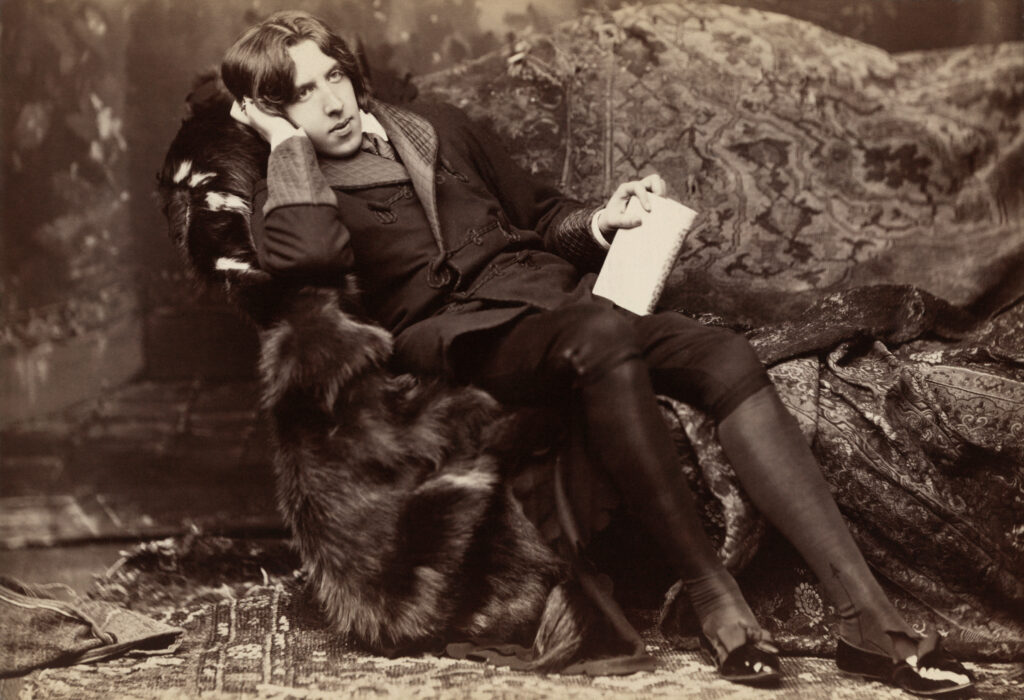
Between 1892 and 1895 Wilde was the toast of London. He wrote four great society comedies in four years: Lady Windermere’s Fan (1892), A Woman of No Importance (1893), An Ideal Husband (1895) and The Importance of Being Earnest (1895). He also wrote Salomé around this time; this French-language play was banned from the English stage for years for its Biblical portrayals.
Earnest opened in February 1895. It is a farce about two men, a made-up friend and a handbag and it has never been out of fashion since. It carries on the Irish comic tradition of Congreve, Farquhar, Goldsmith and Sheridan, writers who looked at English society from the outside and found humour in its pompousness and over the top nature.
The Fall
Within months of that triumph his life fell apart. In 1891 he had met Alfred Douglas, an undergraduate at Oxford known as Bosie, and began a tempestuous and indiscreet affair with him. Douglas had the title ‘Lord’ as his father was Alfred Douglas, the Marquess of Queensberry, of the boxing rules fame. Wilde was publicly denounced by Bosie’s father as being gay. This presented Wilde with a dilemma; to ignore the libel would be to admit he was gay, illegal at the time in the United Kingdom, whereas contesting the libel would be risky as Queensberry’s obvious route to acquittal was to show that the claim was true.
Against the advice of his friends, that he simply flee to France where homosexuality was legal, Wilde took the latter course. Queensberry’s defence lawyer was Edward Carson, a Dubliner and graduate of TCD like Wilde, who was later a prominent figure in Irish and then Ulster Unionism during the Revolutionary period in Ireland. Carson’s approach was to question Wilde on the morality of his writings, especially Dorian Gray, while also drawing out his sexual liaisons with men. While Wilde entertained the court crowd with his wit, Carson won the legal argument and so Wilde lost the suit. He was then himself prosecuted in a very public and publicised trial. In May 1895 he was sentenced to two years’ hard labour for “gross indecency” and served time in Pentonville, Wandsworth and Reading gaols.
If you want to learn more about the trial and the scandals surrounding it, I recommend the two part treatment by the podcast The Rest is History; here are part one and part two.
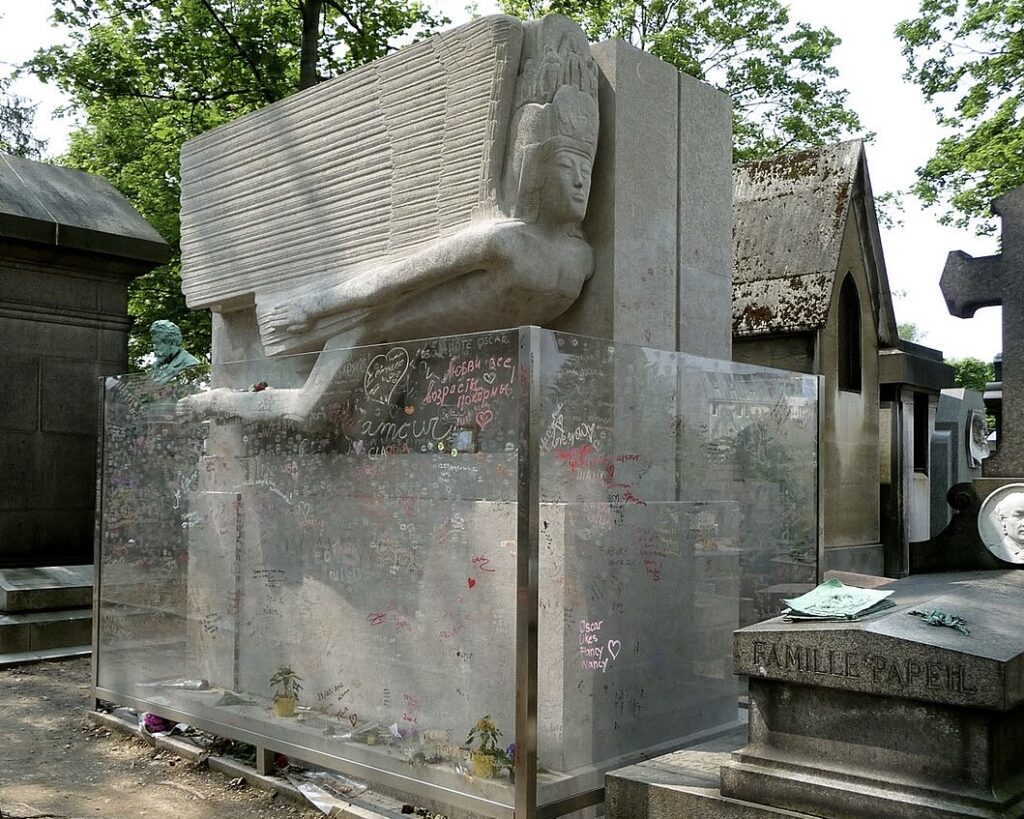
In prison Wilde wrote a long letter that was later published as De Profundis, which means ‘From the Depths’ in Latin. After his release in 1897 he left for France. The Ballad of Reading Gaol was published in 1898 under his cell number, C.3.3, rather than his name. After travelling in Northern France and a brief stay in Italy, where he met Bosie again, Wilde spent the last few years of his life in Paris in a shabby room at the Hôtel d’Alsace. He was ill and short of money; the story goes that he said about the room’s wallpaper, which he hated, “My wallpaper and I are fighting a duel to the death. One of us has got to go.” The wallpaper stayed and Wilde is now buried at Père Lachaise cemetery.
Dublin’s Own
Neither England, Ireland nor Dublin have always honoured Wilde, but today he is one of this city’s best-loved literary figures. A statue reclines in Merrion Square, a writing centre carries his name and he is a central part of Dublin’s story as a UNESCO City of Literature. Similar honours have been given to him in London, where he did so much of his work, and in Paris. He was a Dubliner who wrote the English language’s funniest comedies and its saddest fairy tales, and he ended up a symbol of what intolerance costs.
His legacy is a complex one, even to this day. For much of the last century, he has stood as an icon of LGBTQ+ persecution and a victim of Victorian hypocrisy. Yet in more recent years, some of the details of Wilde’s life and the transcript of the libel trial (rediscovered in 2000) provoke more nuanced reflections. Many of his relationships were with ‘lads’ (a word used in his trial) of 16 and possibly younger. A modern audience might notice the power imbalance of an older, wealthier Wilde and his teenaged partners, many from the underworld of working class sex workers (‘rough trade’ in the parlance of the time) that Wilde was introduced to by the aristocrat Douglas. The first trial is also notable for how Wilde’s prosecuting lawyers called into question the testimony of the ‘lads’, emphasising their lack of education and therefore unreliability. These are difficult questions that we must face, however much we admire Wilde for his art.
Walk it yourself
You can see most of Wilde’s Dublin in one afternoon. All of these points can be found on any tourist map or standard phone map.
- Wilde’s birthplace is at 21 Westland Row. The house has a plaque on the front. It now houses Trinity’s Oscar Wilde Centre for Irish Writing.
- Trinity College Dublin, where he studied Classics. See the Book of Kells and the Long Room of the Old Library.
- The Wilde family home at 1 Merrion Square. This is now the American College Dublin, which offers guided visits.
- The Oscar Wilde Memorial Sculpture is opposite the house, in the corner of Merrion Square. Wilde lounges on a quartz boulder, facing the home where he grew up, with pillars of his sayings beside him.
From the Convention centre, it is roughly a 25-minute walk to Merrion Square. Should you be staying somewhere on the DART line, you can access all these places easily from Pearse Station, which is on Westland Row.
What to read first
New to Wilde? Start with the fairy tales for a quick, beautiful read, then The Canterville Ghost for laughs, then The Picture of Dorian Gray for chills. Finish with The Importance of Being Earnest on a stage, ideally in Dublin or London. If you find yourself in Paris, you could drop into the Père Lachaise cemetery and visit his tomb (see below).
Happy birthday, Oscar!