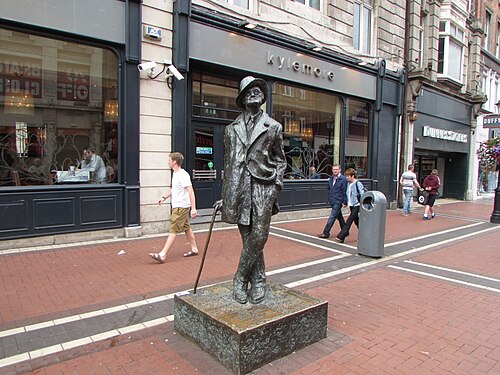
A Beginner’s Guide to Joyce’s Dublin
I have been repeatedly surprised or perhaps impressed by the number of SFF readers, young and old, who have found joy and delight in James Joyce’s renowned novel, Ulysses. It is one of the greatest novels in twentieth century literature, so you can take this as an indication of the breath of its influence.
Now let us get the scary part out of the way first dear reader: you will be relieved to hear that you don’t have to finish Ulysses to walk it.
Joyce’s 1922 novel has a reputation as one of the books people buy, admire on the shelf and never open. It’s a book that changes style almost every chapter and has an intimidating reputation; I’ve already called it one of the greatest novel ever written. Those styles range from relatively straightforward to wild stream of consciousness passages, which notably influenced many of the New Wave writers of science fiction and fantasy in the 60s and 70s.
But bear in mind that it is also an intensely Dublin book; it is utterly immersed in the City, especially its centre. It follows one ordinary day, 16 June 1904, through the streets, pubs, beaches, libraries and chemists of the city. Joyce famously boasted that if Dublin were ever destroyed, it could be rebuilt from the pages of this novel. While you probably can’t read all of it in a weekend, you can walk a good deal of it in an afternoon.
That’s what this series is for. Over several posts, leading to a Bloomsday finale in June, we’ll take you through Joyce’s Dublin one stretch at a time. This first post is your map: what the book is, who’s in it, and the handful of stops that will make the rest of the series (and your visit in 2029) make sense.
Characters
Ulysses follows three people through a single day:
Leopold Bloom – a Dublin advertising canvasser, kind, curious and a little lost, who wanders the city on errands and avoidances. The name Bloom is the same as Blum, found in France and Germany. This link to the rest of Europe is one of many ways the novel is very universal or international as well as intensely local, something that meant a lot to Joyce.
Stephen Dedalus – a young teacher and would-be writer, brilliant and sour, who has recently returned to Dublin and doesn’t quite know why.
Molly Bloom – Leopold’s wife, whom we meet at the start of the day and don’t hear from properly until the very end. Molly Bloom is oe of the most memorable women characters ever written by a man, to say the least.
Structure
The book is divided into eighteen episodes, each loosely matched to a scene from Homer’s Odyssey; the “Ulysses” of the title is the Latin name for Odysseus. Bloom’s wandering around Dublin is a small-scale, human-sized epic: no monsters, or at least not physical ones, but plenty of pubs, funerals and awkward conversations.
You don’t need to know any of the Homeric tale to enjoy the walk. Think of it as a bonus layer, like finding after a viewing that a film you liked was based on a myth or book that you can now enjoy as something extra.
Why Walk it?
Now the central question for this blog: Why a beginner should walk it first?
It’s simple really – the geography does half the work. Stand on the right spot and the book’s best qualities come across without any effort: the sea air, the noise, the wit, the sheer specificity. Many readers who have bounced off the text come away from a walk wanting to try again.
It also helps that Joyce’s Dublin is compact. Most of the central action takes place within a short walk of Trinity College, and Dublin’s historic city centre is famously compact and so easy to explore on foot. Here are some of the essential places. Later posts in the series will go deeper into each area; for now, treat this as your orientation.
The Martello Tower, Sandycove – The novel opens here, on the roof of a squat stone tower on the coast south of the city. Joyce himself stayed in it for a few nights in 1904. It is now the James Joyce Tower and Museum, with striking views across Dublin Bay from the rooftop. Just below is the Forty Foot, the famous sea-swimming spot, where bathers like the ones in the opening scene still turn up in all weathers. Sandycove is a short DART journey from the city centre, so bring your swimming gear and enjoy the brisk and refreshing Irish Sea.
Sandymount Strand – A little further along the bay, this is where Stephen walks, thinking hard about time, sight and language. It’s an easy, atmospheric stretch at low tide, and a good place to understand why Joyce stuck to what he knew.
Glasnevin Cemetery – The funeral of Paddy Dignam, which Bloom attends, brings the story to Glasnevin. It’s a remarkable place in its own right, the resting place of a long list of figures from Irish history, and includes an award-winning museum (with an excellent cafe). As a bonus it is also right next to John Kavanagh’s ‘The Gravediggers’ pub, which serves one of the best pints of Guinness in Dublin (allegedly), along with traditional Dublin coddle that the chef Marco Pierre White described as sensational and one of the few things to ever impress him.
Davy Byrne’s, Duke Street – In the middle of the day, Bloom stops here for a gorgonzola sandwich and a glass of burgundy. Davy Byrne’s is still a working pub, and it’s one of the few places in the city where you can follow in Bloom’s footsteps in the most literal way possible: order the lunch.
Sweny’s Pharmacy, Lincoln Place – Bloom buys a bar of lemon soap here. The old chemist’s shop is now run by volunteers, who sell the soap, hold readings from the book, and keep alive the sense that you’ve stepped into the page. It’s one of the friendliest literary stops in the city and a rare case of a literary or cultural landmark that is not profitable being saved from the developers.
The National Library of Ireland, Kildare Street – The scene where Stephen holds forth on Shakespeare to an audience of Dublin literati is set in the library. It’s free to visit, and the reading room is a lovely place to sit with a book.
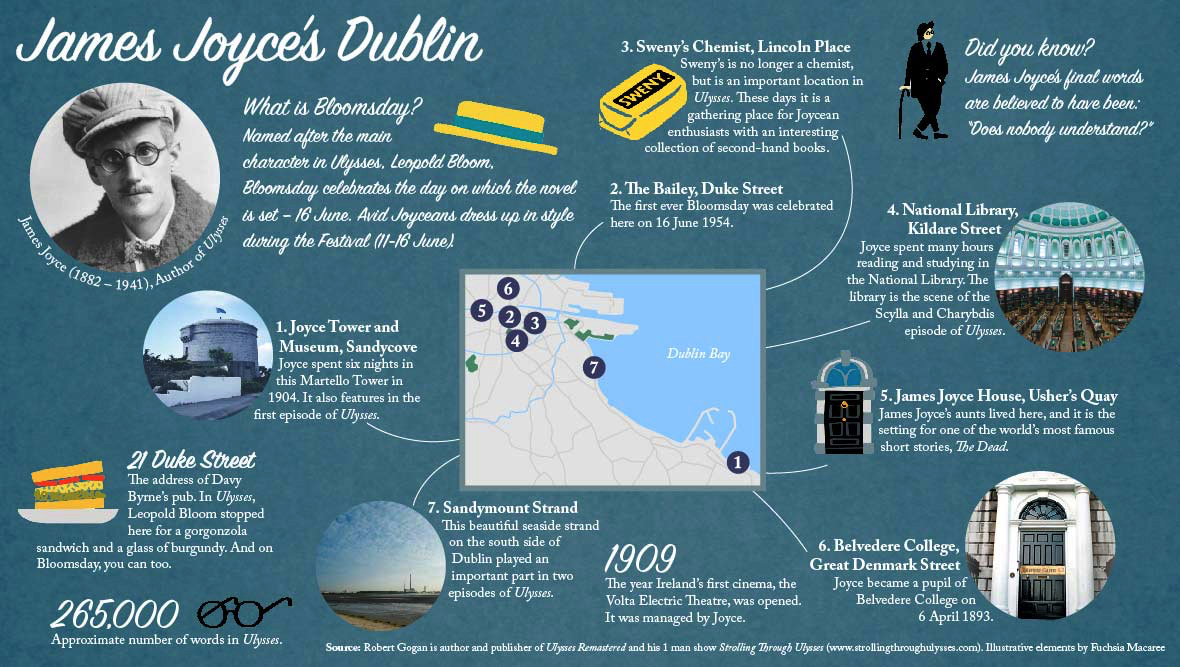
The route from Davy Byrne’s to Sweny’s to the National Library is short enough to do on foot in under an hour, with plenty of time for a pint or a coffee on the way. For Worldcon visitors, the historic central Dublin is roughly a 25 to 35 minute walk from both the Docklands and out=r venues, or you could take the tram and bus if you want to save your legs.
If you want to peek ahead, try this excellent interactive map.
Tips for Neophytes
- Don’t read the whole book first. Read the first chapter (it is gentler than its reputation) and perhaps a few of the stops above, then let the walk do the rest.
- Take a copy with you. Reading a paragraph on the spot is far better than any guidebook.
- Look up the lunchtime scenes. Food and drink are some of the most accessible parts of the book.
- Go at your own pace. Joyce lingered. So can you.
What’s next in the series
This is just the opener. In the posts to come, we’ll slow down and explore Joyce’s Dublin in more detail, telling you about the locations you will visit, and in June we’ll close the series with a Bloomsday celebration, because there is no better time to be in Dublin with this book in your hand.
And in 2029, you could be walking these streets with fellow readers from around the world. If you’d like to be there, support Dublin’s bid for Worldcon 2029 and help bring the world’s science fiction and fantasy community to the city that gave us the greatest novel of the twentieth century, whatever the Joyceans say about its ending.